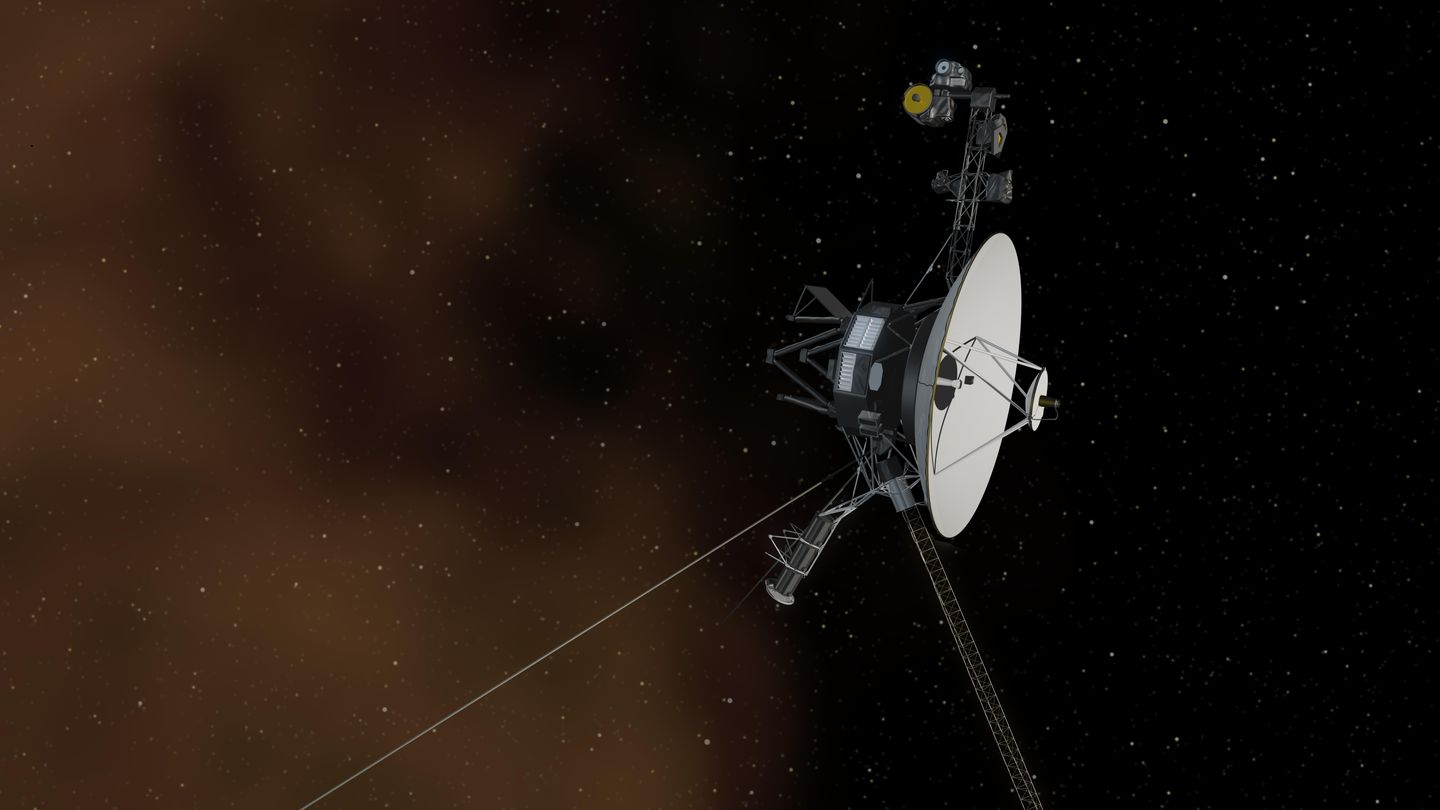
NASA says Voyager 1 has reached a distance where light itself needs a full day to travel between the spacecraft and Earth, a milestone the agency says the probe achieved on Nov. 18.
In a news release published Nov. 19, NASA said Voyager 1 reached one light-day from Earth at 2:16 a.m. PST, or 5:16 a.m. EST, on Nov. 18. The agency defines that distance as about 16.1 billion miles, or 25.9 billion kilometers.
That means a radio signal from the spacecraft now takes about 24 hours to arrive. NASA said team members at the Jet Propulsion Laboratory in Southern California heard from Voyager 1 about 24 hours after the milestone, consistent with that light-travel time.
How NASA said it verified the milestone
NASA said mission engineers did not rely on the spacecraft’s usual science and engineering readouts to confirm the event. The agency said Voyager 1 has not returned that data since Nov. 14, though it is still sending a carrier signal, the transmission that normally carries those data back to Earth.
According to NASA, engineers used that carrier signal together with trajectory calculations to confirm that Voyager 1 had crossed the one-light-day threshold. The agency said the team is still analyzing the issue affecting the science and engineering data.
What the mission has already established
Voyager 1 and Voyager 2 launched in 1977, according to NASA, taking advantage of a rare planetary alignment. NASA said the spacecraft were the third and fourth probes to visit Jupiter and Saturn, and the first to return high-resolution images from those worlds. Voyager 2 later continued to Uranus and Neptune.
NASA also said Voyager 1 became the first spacecraft to leave the heliosphere and enter interstellar space in 2012. Voyager 2 crossed that boundary in 2018 on a different path. The agency says both probes are still measuring changes in the Sun’s magnetic field across enormous distances.
What limits the spacecraft now
The mission’s remaining life is tied closely to power. NASA said both Voyager probes lose about 4 watts of power each year as their radioisotope thermal generators gradually decline. Earlier in 2026, according to NASA, engineers switched off three devices on Voyager 1 and replaced them with three lower-power alternatives to conserve energy.
That energy-saving step is expected, NASA said, to keep the current set of science instruments operating on both spacecraft until at least their 50th launch anniversaries next summer.
For now, the one-light-day milestone is a distance marker, not a sign that Voyager 1’s data issue has been resolved. NASA’s account supports that the spacecraft remains in contact through its carrier signal while engineers continue to investigate the loss of science and engineering telemetry.